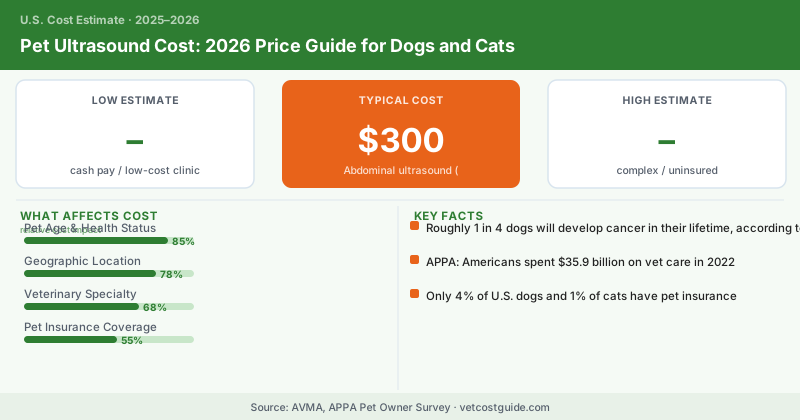
Roughly 1 in 4 dogs will develop cancer in their lifetime, according to veterinary oncology estimates cited by the American Veterinary Medical Association — and ultrasound is often the tool that catches it, or rules it out, before things get dire. Pet ultrasounds typically cost $300–$800 for a standard abdominal scan, with cardiac studies and specialist referrals running higher.
Unlike X-rays, which capture a still image of bone and general shapes, ultrasound uses sound waves to show real-time movement, blood flow, and internal organ texture — which is why it’s the go-to tool for investigating masses, organ disease, and pregnancy.
Typical costs by type
| Ultrasound Type | Typical Cost | Common Reason |
|---|---|---|
| Abdominal ultrasound (general practice) | $300–$500 | Vomiting, mass, organ concern |
| Abdominal ultrasound (specialist/radiologist) | $400–$800 | Complex or ambiguous findings |
| Echocardiogram (cardiac ultrasound) | $400–$800 | Heart murmur, suspected heart disease |
| Pregnancy confirmation ultrasound | $75–$200 | Confirming and dating pregnancy |
| Guided biopsy/aspirate add-on | $150–$400 | Sampling a mass found on ultrasound |
Why the price range is so wide
The single biggest factor is whether a general practitioner or a board-certified specialist performs the scan. Many general vets are trained to perform basic abdominal ultrasounds for straightforward questions — is there fluid, is there an obvious mass, is the pregnancy viable. But detailed studies, ambiguous findings, or cardiac ultrasounds are frequently referred to a veterinary radiologist or cardiologist, whose specialized training and equipment command a higher fee, often $400-$800 for the study plus a formal written report.
Sedation is the other major variable. Anxious or painful pets, and virtually all cardiac ultrasound patients, benefit from mild sedation to stay still enough for a clear, diagnostic-quality scan — adding $75–$200 to the base cost.
- Standard abdominal ultrasounds run $300–$500 at general practice, up to $800 with a specialist.
- Cardiac ultrasounds (echocardiograms) typically cost $400–$800 and are often done by a cardiologist.
- Ultrasound shows real-time organ detail and blood flow that X-rays can’t capture.
- A biopsy or fine-needle aspirate guided by ultrasound adds $150–$400 but often provides a definitive diagnosis.
When your vet recommends it
Ultrasound is usually the next step after bloodwork or X-rays raise a question those tools can’t fully answer. Elevated liver values on a blood panel might prompt an ultrasound to look directly at the liver’s structure. A mass felt during a physical exam gets characterized — solid or fluid-filled, its size and location relative to other organs — before deciding whether surgery or a biopsy is the next step. And unexplained vomiting or lethargy in an older pet is a common trigger for an abdominal scan to check for masses, obstruction, or organ disease.
- Skipping the ultrasound because bloodwork looked “mostly normal.” Organ structure problems, early tumors, and pregnancy don’t always show up in bloodwork — ultrasound catches things blood tests can miss.
- Not asking whether a biopsy will be recommended. If a mass is found, your vet may recommend sampling it on the spot — ask ahead of time so you’re not surprised by an add-on fee during the appointment.
- Assuming general practice and specialist ultrasounds are interchangeable. For ambiguous or high-stakes findings, the extra cost of a board-certified radiologist’s read is often worth it for diagnostic confidence.
Is it worth the cost?
For a genuinely concerning symptom — unexplained weight loss, a palpable mass, persistent vomiting, or an abnormal bloodwork result — an ultrasound often provides the clearest, fastest path to an actual diagnosis, avoiding weeks of guessing with medications that treat symptoms rather than causes. Combined with your pet’s history and bloodwork, it’s one of the most information-dense diagnostics available for the price, and it frequently changes the treatment plan entirely once the vet can actually see what’s going on inside.
Frequently Asked Questions
Neither is universally better — they show different things. X-rays are faster and cheaper and excellent for bones and general shapes, while ultrasound shows internal organ detail, blood flow, and soft tissue structure in real time, making it better for detecting tumors, organ abnormalities, and pregnancy. Vets often use X-rays first, then order an ultrasound if more detail is needed.
Many pets tolerate abdominal ultrasounds while calmly restrained without sedation, especially with a skilled technician, but anxious, painful, or squirmy pets may need light sedation to get clear images, adding $75–$200 to the cost. Cardiac ultrasounds (echocardiograms) sometimes require sedation more often due to the precision needed.
Many general practice veterinarians perform basic abdominal ultrasounds themselves, especially for straightforward questions like checking for fluid or an obvious mass. However, detailed studies, cardiac echocardiograms, and ambiguous findings are often referred to a board-certified veterinary radiologist or cardiologist, which adds a specialist fee but provides a more thorough, expert read.