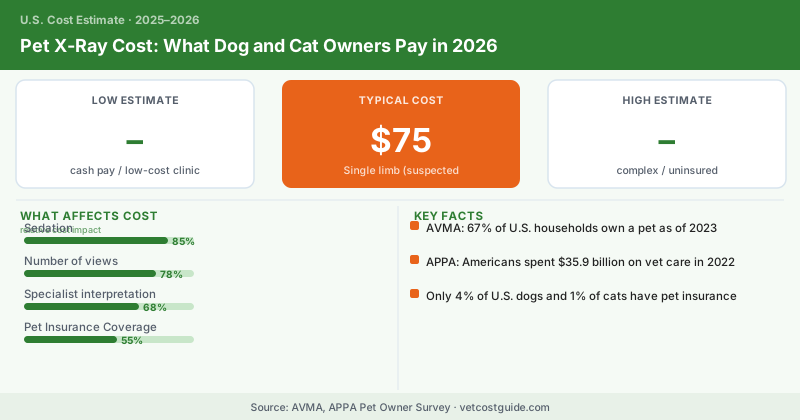
$150 for a single X-ray sounds steep until you understand what’s happening behind the scenes: specialized equipment, radiation safety protocols, and a veterinarian trained to read subtle differences in bone density and soft tissue shadows that most people would never notice. Pet X-rays typically cost $75–$500 depending on the body region, number of views, and whether sedation is required.
X-rays remain one of the most commonly used diagnostic tools in veterinary medicine because they’re fast, relatively affordable compared to advanced imaging like CT or MRI, and answer a huge range of questions — from a swallowed object to a suspected fracture to chronic joint disease.
Typical pricing by scenario
| Scenario | Views Needed | Typical Cost |
|---|---|---|
| Single limb (suspected fracture) | 1–2 views | $75–$200 |
| Chest X-ray (cough, breathing issue) | 2–3 views | $150–$300 |
| Abdominal X-ray (foreign body, bloat) | 2–3 views | $150–$350 |
| Hip X-rays (dysplasia screening, sedated) | 2 views | $200–$400 |
| Full body/multiple regions | 4+ views | $300–$500 |
The base price usually includes the veterinarian’s time to position your pet, the imaging itself, and a professional read of the results. Facilities with digital radiography (most modern clinics) can review images immediately, while older film-based systems add processing time and sometimes cost.
What actually drives the price up
Sedation is the biggest single add-on, running $75–$200 depending on your pet’s size and the drugs used. It’s often necessary for anxious or painful animals, and always necessary for certain specialized positioning like hip dysplasia screening films, which require complete muscle relaxation to get an accurate reading.
Number of views matters just as much as body region. A single view might miss a hairline fracture or an object hiding behind other organs — most diagnostic X-rays require at least two angles, and complex cases can require four or more.
Specialist interpretation adds cost for complicated or ambiguous cases. Your regular vet handles the read for most routine X-rays, but complex orthopedic or oncology cases sometimes get sent to a board-certified veterinary radiologist for a formal report, adding $50–$150.
- Basic single-region X-rays run $75–$200; complex multi-view studies can reach $500.
- Sedation adds $75–$200 but is often necessary for accurate positioning.
- Most diagnostic X-rays require at least two views to be useful.
- Digital radiography (standard at most clinics) allows immediate review with no processing delay.
When X-rays aren’t enough
X-rays are excellent for bones and can detect many soft tissue abnormalities, foreign objects, and fluid buildup, but they don’t show everything. Suspected tumors, some types of internal bleeding, and detailed organ assessment often require an ultrasound instead or in addition. Your vet will typically start with X-rays because they’re faster and cheaper, then recommend ultrasound or advanced imaging only if the X-ray raises more questions than it answers.
- Skipping recommended follow-up views. If your vet suggests additional angles to confirm a diagnosis, skipping them to save money can lead to a missed fracture or object, requiring a repeat visit and duplicate costs later.
- Assuming a clear X-ray means nothing is wrong. Some conditions, particularly soft tissue issues and early-stage disease, don’t show up clearly on X-ray and may need ultrasound or bloodwork to fully rule out.
- Not asking about the sedation risk for senior pets. Older or medically complex pets may need pre-sedation bloodwork ($80–$150) to confirm they’re safe candidates — factor this into your total estimate.
Getting the most value
Ask your vet directly what question the X-ray is meant to answer and whether it’s likely to be conclusive on its own. For chronic conditions like arthritis, a baseline X-ray taken now gives you something to compare against in future years, making it a worthwhile investment even beyond the immediate concern. And always ask whether your pet’s specific situation calls for sedation before the appointment, so the final bill doesn’t come as a surprise.
Frequently Asked Questions
Sedation is needed when a pet is too anxious, painful, or wiggly to hold still for the several seconds required to get a clear image, or when specific positioning (like hip X-rays for dysplasia screening) requires the pet to be completely relaxed and motionless. Sedated X-rays add $75–$200 to the total cost but produce far clearer, more diagnostically useful images.
Yes, most accident-and-illness pet insurance plans cover diagnostic X-rays when they're used to investigate an injury or illness, reimbursing 70–90% after your deductible. X-rays taken purely for routine screening without a specific medical concern may not be covered under standard plans unless you have an added wellness rider.
Most orthopedic or abdominal concerns require at least two views (front-to-back and side-to-side) to give the vet a complete picture, and some conditions like hip dysplasia screening or complex fractures may require three or more angles. Each additional view typically adds $25–$75 to the base cost.