It’s 11 PM. Your dog is pacing, can’t get comfortable, and his belly looks bigger than usual. Do you drive 45 minutes to the emergency clinic, pay the after-hours fee, and sit in a waiting room until 2 AM? Or does it wait until your regular vet opens at 8?
That call is one of the hardest in pet ownership. Go too often and you’re spending $500 to hear your dog ate too fast. Wait too long on the wrong symptom and you’re dealing with a crisis that might have been manageable hours earlier.
Know this framework before you need it. The ASPCA Animal Poison Control Center alone handles over 400,000 calls a year — people making exactly this kind of judgment call in real time. Having a clear mental map matters.
Go to the Emergency Vet Right Now — No Waiting
These symptoms mean something potentially life-threatening is happening. Don’t wait for your regular vet to open. Don’t call to see if you should come in. Go.
Difficulty breathing or labored breathing: Open-mouth breathing in a cat is always an emergency. Cats don’t pant like dogs — if a cat is mouth-breathing, something is seriously wrong. In dogs, look for an extended neck, visible effort with each breath, blue or gray gums, or breathing that’s rapid and shallow even at rest.
Collapse or sudden inability to stand: Sudden weakness in the hindquarters (looks like “the back end went out”), falling over, or inability to rise that came on quickly.
Suspected toxin ingestion: If you saw your pet eat something toxic — grapes, raisins, xylitol (in sugar-free products), rodenticides, certain mushrooms, human medications — go immediately. Don’t wait for symptoms. Many toxins cause no visible signs until organ damage has already occurred. The ASPCA Animal Poison Control Center (888-426-4435) can advise you while you drive.
Seizure lasting more than 5 minutes, or multiple seizures within a few hours: A single brief seizure in a dog with a known seizure disorder may follow a protocol your vet has already given you. First-time seizures, prolonged seizures, or cluster seizures are emergencies.
Uncontrolled bleeding: Bleeding that doesn’t slow significantly with 5 minutes of firm direct pressure.
Eye injury or sudden vision change: Eyes are time-sensitive. A scratched cornea, penetrating injury, or sudden blindness can worsen rapidly without treatment.
Suspected broken bone: Your pet is non-weight-bearing on a limb with visible swelling or an abnormal angle.
Inability to urinate: See the warnbox below — this is a five-alarm emergency for male cats in particular.
Bloat/GDV in large dogs: A distended abdomen (visibly bloated, especially behind the ribs), unproductive retching or gagging (trying to vomit but bringing nothing up), restlessness, and drooling in a large or deep-chested dog — Great Danes, German Shepherds, Labs, Standard Poodles, Weimaraners — is a surgical emergency. Gastric dilatation-volvulus twists the stomach, cutting off blood supply. Without surgery within hours, it’s fatal.
A male cat straining to urinate — squatting in the litter box with little or no output, crying, or obsessively licking at his genitals — is a life-threatening emergency. A blocked urethra can cause bladder rupture and systemic toxicity within 24–48 hours. This is not a “watch and see” situation, even at midnight. Female cats and dogs can develop blockages too, but male cats are far more commonly affected due to their narrower urethras.
Urgent — Call Your Vet or an Emergency Line First
These need veterinary attention within hours, but you may have time to call ahead, get guidance, or be seen at an urgent care clinic rather than a full ER.
Vomiting or diarrhea more than 2–3 times in a few hours, especially if bloody or if the pet seems lethargic. A single episode of vomiting usually isn’t an emergency. Persistent vomiting combined with lethargy changes the equation.
Moderate lameness: Not putting full weight on a leg but still able to move around. If the dog was running and is now limping but mobile, same-day urgent care often works. If the leg is dangling abnormally or the dog won’t touch it to the ground, go to the ER.
Small lacerations that aren’t bleeding heavily but might need sutures. Cuts under an inch long and bleeding slowly can usually wait until morning. A gaping wound with separated edges needs attention sooner.
Significant facial swelling that comes on suddenly, especially around the face and muzzle — could be an allergic reaction. If breathing seems affected, that escalates to emergency.
Wait for Your Regular Vet
Real issues, worth addressing — just not in the middle of the night.
- Minor ear scratching or head shaking (not violent, not constant)
- Mild coughing that’s been present a few days and isn’t getting worse
- Small lump or bump that hasn’t changed
- Limping that was worse yesterday and is clearly improving today
- Single episode of vomiting with normal behavior before and after
- Mild eye discharge (not acute, not squinting)
When in doubt, call an emergency clinic and describe what you’re seeing. Most will tell you honestly whether it warrants driving in.
| Facility Type | Exam/Triage Fee | When to Use |
|---|---|---|
| Emergency vet clinic (after hours) | $100–$200 triage fee | True emergencies, nights and weekends |
| Urgent care/daytime ER | $75–$150 | Same-day issues, clinics are full |
| 24-hour animal hospital | $100–$250 | Major emergencies, surgical capability |
| Regular vet (scheduled) | $50–$100 | Routine and non-urgent issues |
| Telehealth vet consultation | $25–$75 | Guidance on whether to go in |
What to Do on the Drive to the Emergency Vet
Keep your pet as calm and still as possible. For injured pets, don’t attempt to splint or bandage unless there’s severe, active bleeding. Blankets and towels for warmth are fine. Don’t muzzle a pet that’s having trouble breathing.
Call ahead if you can. A 5-minute heads-up lets the ER team prepare — especially for GDV or obvious respiratory emergencies where immediate triage matters.
Bring whatever they might have ingested. If you think it was a toxin, bring the packaging. Found chewed medication? Bring the bottle. This saves critical time.
What to Tell Them When You Arrive
Lead with the most important information: what’s happening, when it started, and what changed. “She was fine at 7 PM and now she can’t stand” is more useful initially than a full history. They’ll ask for the rest.
Know your pet’s current medications, any recent diet changes, and any known health conditions. If your pet has a regular vet, most emergency clinics can pull records — but knowing the basics yourself speeds things up considerably.
Look up your nearest 24-hour emergency veterinary clinic right now and save the address and phone number in your phone. The worst moment to be Googling “emergency vet near me” is at midnight when your dog just collapsed. Many areas have both a smaller after-hours clinic and a larger full-service specialty hospital — knowing which is equipped for what (the full hospital has a blood bank and ICU) helps you make better decisions under pressure.
The Cost Question
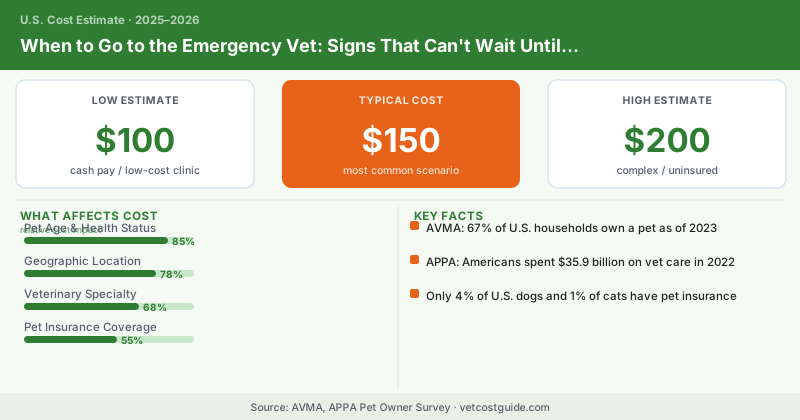
Emergency veterinary care is expensive. Triage fees of $100–$200 before any treatment begins are standard at most 24-hour clinics. A moderate overnight emergency — IV fluids, monitoring, diagnostics — often runs $800–$2,000. Major interventions like GDV surgery or urinary blockage management with several days of hospitalization can reach $4,000–$8,000.
That reality shouldn’t stop you from going when you need to. Most emergency clinics will work with you on payment plans, and many accept CareCredit. If cost is a real barrier and symptoms are in the “maybe” category, a telehealth vet consultation ($25–$75) can help you assess urgency before you commit to the ER triage fee.
When the symptoms above are present — difficulty breathing, suspected toxin, urinary blockage, bloat — cost cannot be the deciding factor. Those conditions are measured in hours.
Frequently Asked Questions
Emergency vet visits typically cost $100–$200 just for the initial exam fee, with additional charges for diagnostics, medications, or procedures on top of that baseline. A full emergency visit with bloodwork, X-rays, or IV fluids can easily reach $500–$2,000 depending on what your pet needs. After-hours visits (evenings, nights, and weekends) often include a premium surcharge beyond standard daytime rates.
Most pet insurance plans do cover emergency vet visits, typically reimbursing 70–90% of eligible costs after you meet your deductible (usually $250–$500 per year). However, many policies exclude certain conditions like pre-existing illnesses, orthopedic issues, or breed-specific conditions, so you should review your plan details before an emergency strikes. Without insurance, you'll pay the full cost out-of-pocket at the time of service.
Waiting is safe for non-emergency issues like mild vomiting, slight limping, or ear discharge—your regular vet can see these within 24 hours. However, if your pet shows signs of severe pain, difficulty breathing, unconsciousness, uncontrolled bleeding, inability to urinate or defecate, or signs of bloat (restlessness and a distended belly), go to the emergency clinic immediately, as these conditions can become life-threatening within hours.