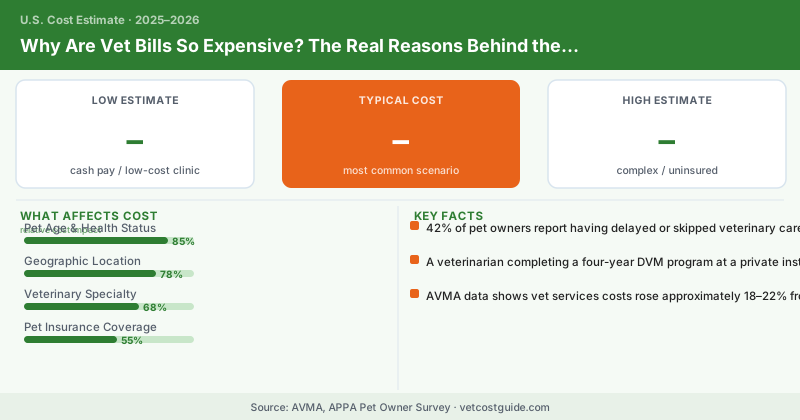
42% of pet owners report having delayed or skipped veterinary care due to cost concerns, according to the AVMA’s Pet Ownership and Demographic Sourcebook. That statistic captures something real: the sticker shock at a veterinary clinic is genuine, and it often feels disconnected from the experience of a 20-minute exam and a few medications.
So where does the money actually go?
Veterinarians Graduate With Medical School Debt
This is the starting point that most people don’t see. A veterinarian completing a four-year DVM program at a private institution graduates with an average of $170,000–$200,000 in student loan debt, according to AVMA data. At public institutions the number is somewhat lower — closer to $130,000–$160,000 — but it’s still enormous.
Veterinarians don’t earn doctor-level salaries the way MDs do. The median salary for a veterinarian in the US is around $120,000–$135,000/year. That’s a good income — but it’s often barely sufficient to service six-figure debt while running or working in a practice with significant overhead. The student loan burden gets baked into what vets need to charge to make the profession financially viable.
The Equipment Cost Is Comparable to Human Medicine
Modern veterinary medicine uses the same diagnostic technology as human medicine:
- Digital radiography (X-ray) systems: $40,000–$100,000
- Ultrasound machines: $25,000–$80,000
- MRI machines (at specialty centers): $500,000–$2,000,000
- CT scanners: $400,000–$1,000,000
- In-house laboratory analyzers: $15,000–$50,000
- Surgical monitoring equipment: $10,000–$30,000
- Anesthesia machines: $8,000–$25,000
A well-equipped small animal practice might have $300,000–$500,000 in diagnostic and surgical equipment. That equipment requires maintenance contracts, software updates, calibration, and eventual replacement. Those costs flow through to the per-visit prices you see.
When you pay $250 for a vet visit with bloodwork, you’re paying for: the DVM’s 8 years of education, a licensed technician’s time, the equipment that ran your bloodwork, clinic rent (often $5,000–$20,000/month in urban areas), medical supply costs, malpractice insurance, software systems, staff salaries, and a margin that pays the clinic’s debt service. The $65 exam fee rarely covers the actual cost of the 20-minute appointment.
Overhead Is Enormous
Veterinary clinics operate with overhead ratios of 60–75% — meaning for every $1 collected, $0.60–$0.75 goes to expenses before anyone takes home a dollar. Those expenses include:
- Rent: A clinic in a suburban location might pay $8,000–$20,000/month for sufficient space
- Staff salaries: Registered veterinary technicians (RVTs) earn $40,000–$65,000/year; front desk staff, kennel techs, and assistants are additional payroll
- Medical supplies: Controlled substances, suture material, IV fluids, bandaging, and pharmaceuticals are expensive and strictly regulated
- Insurance: Malpractice (professional liability), general liability, property — often $15,000–$40,000/year for a small practice
- Software: Practice management software, PACS for imaging, laboratory interfaces
- Regulatory compliance: DEA licensing for controlled substances, OSHA requirements, state veterinary board compliance
The business of running a veterinary clinic is genuinely expensive, and unlike human medicine, there’s no insurance reimbursement at pre-negotiated rates propping up the system.
There’s No Insurance Subsidy Like in Human Medicine
In human medicine, hospitals negotiate contracts with major insurers and Medicare/Medicaid that set rates. Even if a procedure “costs” $8,000, the insurer might have a contracted rate of $2,400, and that’s what gets paid. The hospital writes off the difference.
Veterinary medicine has no equivalent mechanism. Pet insurance companies reimburse pet owners, not vets — and they don’t negotiate rates. Vets charge market rates and collect them directly. There’s no system of cross-subsidization, negotiated contracts, or government payer backstops. Every dollar a vet collects has to cover actual costs plus a margin.
| Cost Driver | Estimated Impact on Your Bill |
|---|---|
| Equipment (amortized) | 15–25% |
| Rent and facilities | 15–20% |
| Staff salaries | 25–35% |
| Medications and supplies | 10–20% |
| Vet's compensation + debt service | 15–25% |
| Insurance and compliance | 5–10% |
Specialist Training Commands Specialist Pricing
Board-certified veterinary specialists — internists, surgeons, oncologists, cardiologists, neurologists, ophthalmologists — complete a 4-year DVM, then 1–3 years of internship and residency, then pass board certification exams. This is 8–11 years of post-graduate training. In many regions there are very few of them.
A veterinary surgeon performing a TPLO (tibial plateau leveling osteotomy) on your dog’s torn cruciate ligament is doing a technically demanding orthopedic procedure. The $4,500–$7,000 price tag reflects their training, the specialist equipment, the surgical team, and the post-operative monitoring. Human orthopedic surgeons charge $30,000–$80,000 for similar-complexity procedures; the insurance system obscures that number from patients.
Consolidation Has Changed the Industry
Over the past decade, large corporate groups — VCA, Banfield (Mars Petcare), National Veterinary Associates, and others — have acquired thousands of independent practices. Corporate ownership tends to standardize pricing at or above market rates and introduces profit margin requirements that independent practices don’t always face.
This isn’t inherently wrong, but it means the “keep prices low to serve the community” philosophy of an independent practice owner is sometimes replaced by shareholder return targets.
Not all price increases are greed. Veterinarians often work physically and emotionally exhausting jobs for less compensation than the debt they carry seems to justify. Compassion fatigue and burnout are serious issues in the profession. When costs rise, it’s often because the economics of making veterinary medicine a sustainable career are genuinely difficult — not because someone is profiteering on your love for your pet.
FAQ
Why did my vet bill double in the last five years? Veterinary cost inflation has run well ahead of general inflation since 2020. Supply chain disruptions raised medication and supply costs. The pandemic created pent-up demand while reducing veterinary workforce capacity. Inflation in commercial real estate raised clinic overhead. AVMA data shows vet services costs rose approximately 18–22% from 2020 to 2024, exceeding general consumer price inflation.
Are there cheaper vets that provide the same quality? Veterinary school teaching clinics, ASPCA clinics, and some humane society practices provide comparable care at lower prices. Quality varies but is often excellent — especially at teaching hospitals with faculty oversight. Geographic variation is also significant: the same procedure can cost 40–60% more in urban areas vs. rural or suburban locations.
Should I shop around for vet prices? Yes, especially for non-emergency procedures. Calling 3–4 clinics for a price on an elective procedure (spay, neuter, dental cleaning) is normal and can reveal meaningful price differences. For emergency care, the nearest emergency clinic is usually the right choice regardless of price.
Frequently Asked Questions
A standard wellness exam typically ranges from $50 to $150, while basic bloodwork (CBC and chemistry panel) adds another $100 to $300 depending on your location and clinic. Combined, expect to budget $150 to $450 for a routine checkup with basic lab work at most US veterinary clinics.
Most standard pet insurance plans do not cover routine exams, vaccinations, or preventive care, leaving these costs as out-of-pocket expenses for pet owners. Some insurers offer optional wellness or preventive add-ons for an extra $10 to $50 per month that reimburse a portion of exams and vaccines after you meet a deductible.
Veterinary clinics invest heavily in diagnostic equipment (digital X-rays, ultrasound, lab machines) and facility overhead that gets distributed across all patient visits; these costs typically represent 30–50% of your bill. You can always request an itemized invoice from your vet to see exactly what you are paying for, including exam fees, medications, equipment usage, and facility charges.